How to invest in NBFC bonds in India: step-by-step guide for retail investors

Quick Answer
To invest in NBFC bonds (NCDs) in India: open a Demat and trading account with a SEBI-registered broker, complete KYC, then either apply for an open NBFC NCD public issue via ASBA or UPI (minimum Rs. 10,000), or buy a listed NBFC bond in the secondary market on NSE or BSE through your broker or a SEBI-registered OBPP platform such as BondScanner. Settlement takes 6 working days for primary issues and T+1 for secondary market trades.
Introduction
NBFC bonds issued as Non-Convertible Debentures (NCDs) by companies such as Bajaj Finance, Tata Capital, Muthoot Finance, and Shriram Finance offer retail investors yields of 7.4% to 13%+, meaningfully higher than bank fixed deposits. But for a first-time investor, the actual process of buying an NBFC bond can feel unclear: where do you go, what documents do you need, how much can you start with, and how do you know which bond is right for you?
This guide walks through the complete process step by step from opening the right account to placing your first order for both the primary market (new NCD issues) and the secondary market (already-listed bonds).
All content is educational and does not constitute investment advice.
What Are NBFC Bonds (NCDs)?
NBFC bonds are Non-Convertible Debentures (NCDs) issued by Non-Banking Financial Companies to raise capital from investors. When you invest, you are lending money to the NBFC for a fixed period in exchange for periodic coupon payments and return of principal at maturity.
NBFC NCDs are regulated under SEBI's NCS Regulations 2021, credit-rated by CRISIL/ICRA/CARE/India Ratings, listed on NSE and BSE, and held in Demat form.
For a deeper look at how NBFC bond rates compare to FDs, refer to NBFC Bond Interest Rates in India 2026.
Who Can Invest in NBFC Bonds in India?
● Resident Individual Indians
● Hindu Undivided Families (HUFs)
● Non-Resident Indians (NRIs), subject to FEMA regulations
● Companies, trusts, partnership firms, and LLPs
● Banks and financial institutions
Most public NCD issues reserve a category for individual retail investors applying up to Rs. 10 lakh, with allotment on a first-come-first-served basis within that category.
Minimum Investment for NBFC Bonds
| Route | Minimum Investment | Notes |
|---|---|---|
| Primary market (NCD public issue) | Rs. 10,000 | Typically 10 bonds at Rs. 1,000 face value each; some issues allow application in higher multiples only |
| Secondary market (listed NCDs) | One bond unit at market price | Market price may be below, at, or above Rs. 1,000 face value depending on the bond's YTM and remaining tenure |
| SEBI-registered OBPP platform | Varies — often one unit at market price | Platforms such as BondScanner allow fractional access to listed bonds at the prevailing market price |
There is no upper limit for retail individual investors beyond the Rs. 10 lakh category threshold in primary issues — investments above this amount are processed under the "High Net Worth Individual" or institutional categories with potentially different allotment proportions.
Step 1: Open a Demat and Trading Account
NBFC bonds are held in Demat form a Demat and trading account is required.
If you already invest in stocks or mutual funds via Demat, no new account is needed.
If you do not have one, open it with any SEBI-registered broker (Zerodha, Groww, HDFC Securities, ICICI Direct, Angel One). Most offer fully online opening completed within a day.
Documents required: PAN card, Aadhaar card, cancelled cheque or bank statement, passport-size photo. Account opening includes video KYC with selfie liveness verification.
For details on the liveness verification step, refer to Selfie Liveness Detection: How It Protects You from Biometric Fraud.
Step 2: Complete KYC Verification
KYC is mandatory before any bond transaction:
1. PAN verification - primary identifier for tax reporting
2. Aadhaar-based eKYC - digital identity verification
3. Bank account verification - via penny drop, confirming the account is active and the name matches KYC records
4. Selfie liveness check - confirms a real, present individual is completing KYC
If you have an existing CKYC record, most brokers and OBPPs can fetch it, reducing the process to minutes.
For details, refer to Bank Account Verification in India: What Is Penny Drop.
Step 3: Choose Primary or Secondary Market
| Factor | Choose Primary Market If... | Choose Secondary Market If... |
|---|---|---|
| Availability | An NCD issue from your preferred NBFC is currently open | No relevant primary issue is open, or you want immediate access |
| Price | You want to invest at exactly face value (Rs. 1,000 per bond) | You are comfortable evaluating YTM at a market-determined price |
| Choice of issuers | You are fine with whichever NBFC currently has an open issue | You want to choose from a wide range of issuers, ratings, and tenures immediately |
| Timing | You can apply on Day 1 — popular issues close within hours | You want to invest on your own schedule, any working day |
| Settlement speed | You are comfortable waiting up to 6 working days for allotment | You want the bond credited to your Demat account the next working day (T+1) |
Step 4: Evaluate the NBFC Bond Before Investing
Before applying or buying, check these five things:
1. Credit rating and outlook — AAA, AA, A, or BBB from CRISIL, ICRA, or CARE, and whether the outlook is Stable or Negative. Refer to Credit Rating Agencies in India: CRISIL, ICRA, CARE Explained.
2. YTM, not coupon rate — In the secondary market, the Yield to Maturity at the current price is the real return. In the primary market at face value, YTM equals the coupon rate.
3. Secured or unsecured — Secured NCDs have asset backing with a minimum 1.0x asset cover ratio; unsecured NCDs carry higher recovery risk in default.
4. Coupon frequency — Monthly, quarterly, annual, or cumulative. Choose based on whether you need regular income or are reinvesting for growth.
5. Issuer financials — For NBFCs specifically: Net NPA ratio (lower is better, ideally under 3–4%), Capital Adequacy Ratio (RBI mandates a minimum of 15% for NBFCs), and AUM growth relative to credit cost trends.
For the full evaluation framework, refer to How to Read a Bond Offer Document in India.
Step 5: Apply via Primary Market (NCD Public Issue)
1. Find the open issue NSE's NSEgoBID, BSE's BSEDirect, or a SEBI-registered OBPP such as BondScanner
2. Log in to your broker, bank app, or OBPP and navigate to IPO / Bonds / NCD section
3. Select issuer and series review tenure and coupon frequency across the 3–5 series typically offered
4. Enter the application amount minimum Rs. 10,000
5. Choose ASBA or UPI
○ ASBA: bank blocks the application amount until allotment
○ UPI: approve the block mandate within 30 minutes
6. Submit the application receive a confirmation reference number
7. Wait for allotment within 6 working days of issue closure
8. Bonds credited to Demat unallotted amounts released back to your account
Important: Apply on Day 1. Several large NBFC NCD issues in FY2026 closed within hours due to high demand.
For tracking open issues, refer to Upcoming NCD Issues in India 2026: How to Buy Online
Step 6: Buy via Secondary Market (Listed NCDs)
1. Identify the NCD by ISIN or issuer name — each series has a unique 12-character ISIN
2. Search on your broker's debt segment or on BondScanner — filter by issuer, rating, or tenure
3. Review current market price and YTM — YTM at current price is your actual return
4. Check the credit rating — confirm it is current; ratings are periodically reviewed
5. Check trading volume — thinly traded bonds may have wide bid-ask spreads
6. Place a buy order — enter the ISIN, set market or limit order, confirm
7. Settlement on T+1 — credited to Demat next working day
For the complete process, refer to Bond Secondary Market in India: How Trading and Settlement Works.
Some of the Best NBFC Bond Platforms in India
| Platform Type | Examples | What They Offer | Best For |
|---|---|---|---|
| Full-service and discount brokers | Zerodha, Groww, ICICI Direct, HDFC Securities, Angel One | Equity + debt segment access; primary NCD applications and secondary market trading | Investors who already use the broker for equities and want bonds in the same account |
| Bank investment platforms | SBI, HDFC Bank, ICICI Bank, Axis Bank apps | Primary NCD applications via net banking or mobile app under IPO/investment section | Investors who prefer applying through their existing banking relationship |
| SEBI-registered OBPP platforms | BondScanner and similar platforms | Aggregated listed bond inventory with standardised disclosures — credit rating, YTM, coupon, maturity, and security type in one interface | Investors who want to compare NBFC bonds across issuers, ratings, and tenures without navigating multiple exchange pages |
To explore currently available NBFC bonds with standardised disclosures, visit bondscanner.com/bonds.
How to Choose the Best Suited NBFC Bonds to Invest In
| If Your Priority Is... | Look For | Indicative Yield Range |
|---|---|---|
| Lowest possible credit risk | AAA-rated NBFCs — Bajaj Finance, Tata Capital, HDB Financial Services | 7.4%–8.3% p.a. |
| Higher yield with moderate risk | AA-rated NBFCs — Shriram Finance, Muthoot Finance, Mahindra Finance, L&T Finance | 8.0%–9.5% p.a. |
| Regular monthly income | NCDs with monthly coupon frequency — available across rating categories | Varies by rating |
| Long-term compounding | Cumulative NCDs with 3–5 year tenure | Varies by rating |
| Gold-backed security | Gold loan NBFCs — Muthoot Finance, Manappuram Finance (asset-backed lending reduces credit risk relative to headline rating) | 8.5%–10% p.a. |
Yields indicative as of Q2 2026. Not a recommendation. Always verify current ratings and rates before investing.
For a detailed issuer-by-issuer comparison, refer to NBFC Bond Interest Rates in India 2026.
After You Invest: Tracking Coupons and Maturity
Once invested, here is what happens:
Coupon payments: Credited directly to your bank account linked to your Demat account on the dates specified in the offer document monthly, quarterly, semi-annual, or annual depending on the series you chose.
Tracking your holdings: Your Demat account statement (from CDSL or NSDL) shows all bond holdings, including NBFC NCDs, alongside your equity and mutual fund holdings.
Maturity: On the maturity date, the face value (principal) is credited to your linked bank account automatically — no action required from you.
Before maturity, if you need to exit: Sell in the secondary market on NSE or BSE at the prevailing market price through your broker or OBPP platform.
For details on coupon payment schedules, refer to Bond Coupon Payment Schedule: How and When Interest Is Credited.
Common Mistakes First-Time NBFC Bond Investors Make
Comparing coupon rate instead of YTM in the secondary market — the printed coupon only equals your return at exactly face value.
Applying late in a primary issue — popular NBFC NCD issues have closed within hours. Apply on Day 1.
Ignoring the credit rating outlook — a Negative outlook on AA is more cautious than Stable on A+.
Treating all NBFC bonds as equally safe — the rating spectrum spans AAA to BBB, a 400–600+ bps yield difference reflecting meaningfully different default risk.
Not checking secured vs unsecured status — same coupon rate can mean very different recovery prospects in default.
Overconcentrating in one issuer — diversify across issuers, ratings, and tenures.
Taxation on NBFC Bond Investments
Coupon income: Taxed as "Income from Other Sources" at slab rate. No TDS on listed NCDs in Demat form for resident Indians self-reporting in ITR mandatory.
Capital gains on sale before maturity:
● Within 12 months: STCG at slab rate
● After 12 months: LTCG at 12.5% without indexation
At maturity: No capital gains tax for standard coupon-bearing NCDs held to maturity.
For a complete breakdown, refer to Taxation on Bonds in India: Comprehensive Guide
FAQs
How do I invest in NBFC bonds in India?
Open a Demat and trading account with a SEBI-registered broker, complete KYC, and either apply for an open NBFC NCD public issue via ASBA or UPI, or buy a listed NBFC bond on NSE or BSE through your broker or a SEBI-registered OBPP such as BondScanner.
What is the minimum investment for NBFC bonds in India?
Rs. 10,000 for most NBFC NCD public issues typically 10 bonds at Rs. 1,000 face value. In the secondary market, you can buy a single unit at the prevailing market price.
Which platform is best for investing in NBFC bonds in India?
Any SEBI-registered broker supporting the debt segment, bank investment platforms, or SEBI-registered OBPP platforms such as BondScanner, which aggregate listed NBFC bonds with standardised disclosures in one interface.
How do I choose the best NBFC bonds to invest in?
Evaluate credit rating and outlook, check secured vs unsecured status, compare YTM rather than coupon rate, review Net NPA ratio and Capital Adequacy Ratio, and match tenure and coupon frequency to your needs.
Can I invest in NBFC bonds without a Demat account?
No. NBFC bonds (NCDs) are held in Demat form a Demat and trading account is required for both primary and secondary market.
How long does it take to receive NBFC bonds after investing? Primary market: allotment within 6 working days of issue closure. Secondary market: T+1 settlement.
Are NBFC bonds covered by deposit insurance like bank FDs?
No. NBFC bonds are not covered by DICGC insurance (which protects bank deposits up to Rs. 5 lakh). Safety depends on the credit rating and financial health of the issuing NBFC.
What is the NBFC NCD investment process for a first-time investor?
1.Open a Demat and trading account if needed. 2) Complete KYC including PAN, Aadhaar, bank verification, and selfie liveness check. 3) Choose primary or secondary market. 4) Evaluate credit rating, YTM, and security type. 5) Apply via ASBA/UPI or place a buy order by ISIN. 6) Track allotment/settlement and receive coupons as scheduled.
This article is published by BondScanner, a SEBI-registered Online Bond Platform Provider (OBPP). Links to BondScanner's bond listing page, Android app, and iOS app referenced in this article are for informational purposes only.
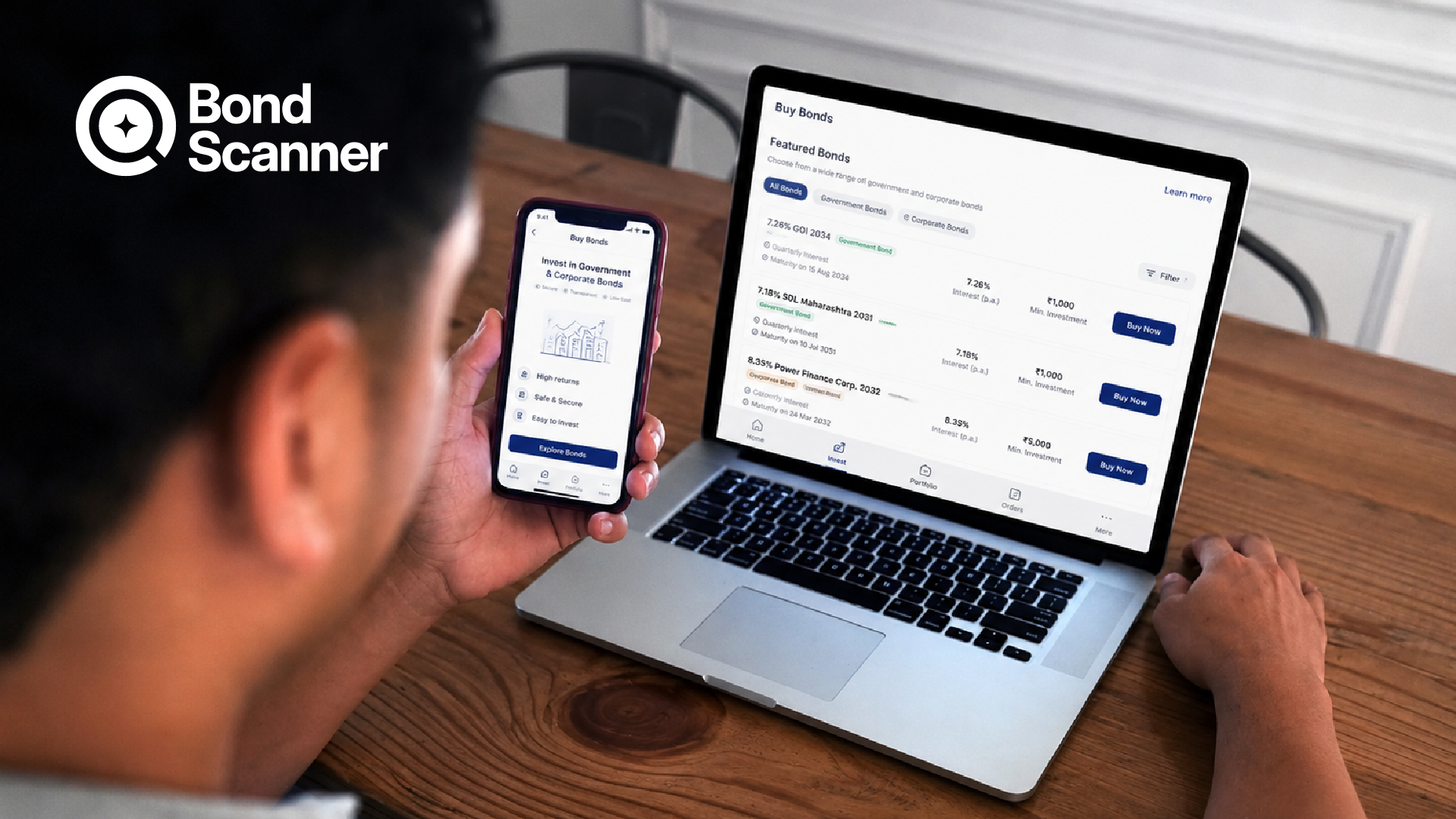
Explore listed bonds on the BondScanner app:
Disclaimer
This blog is intended solely for educational and informational purposes. The instruments, issuer categories, yield ranges, and examples mentioned herein are illustrative and should not be construed as investment advice or recommendations.
BondScanner is a SEBI-registered OBPP and does not provide personalised investment advice. Nothing in this article is a solicitation to buy or sell any security.