Silver ETFs vs bonds in India 2026: How they compare as investments

Introduction
Silver has been one of the most talked-about assets in India in 2025 and 2026. Silver ETF assets under management grew by over 126% between June 2024 and May 2025, crossing Rs. 16,866 crore outpacing even gold ETF growth in percentage terms during the same period. For retail investors watching these numbers, the natural question is: how does silver as an investment actually compare to bonds?
The answer requires understanding that silver ETFs and bonds are fundamentally different instruments they serve different purposes, carry different risk profiles, and suit different investor objectives. Silver ETFs offer no coupon income, no capital guarantee, and high price volatility. Bonds offer contractually defined income, capital return at maturity, and substantially lower volatility. Neither is universally better they serve different functions in a portfolio.
This article explains how to invest in silver in India through ETFs, covers the major silver ETF options available in 2026, and provides a structured comparison of silver ETFs against bonds on every dimension that matters for a fixed-income investor. All content is educational and does not constitute investment advice.
What Is a Silver ETF?
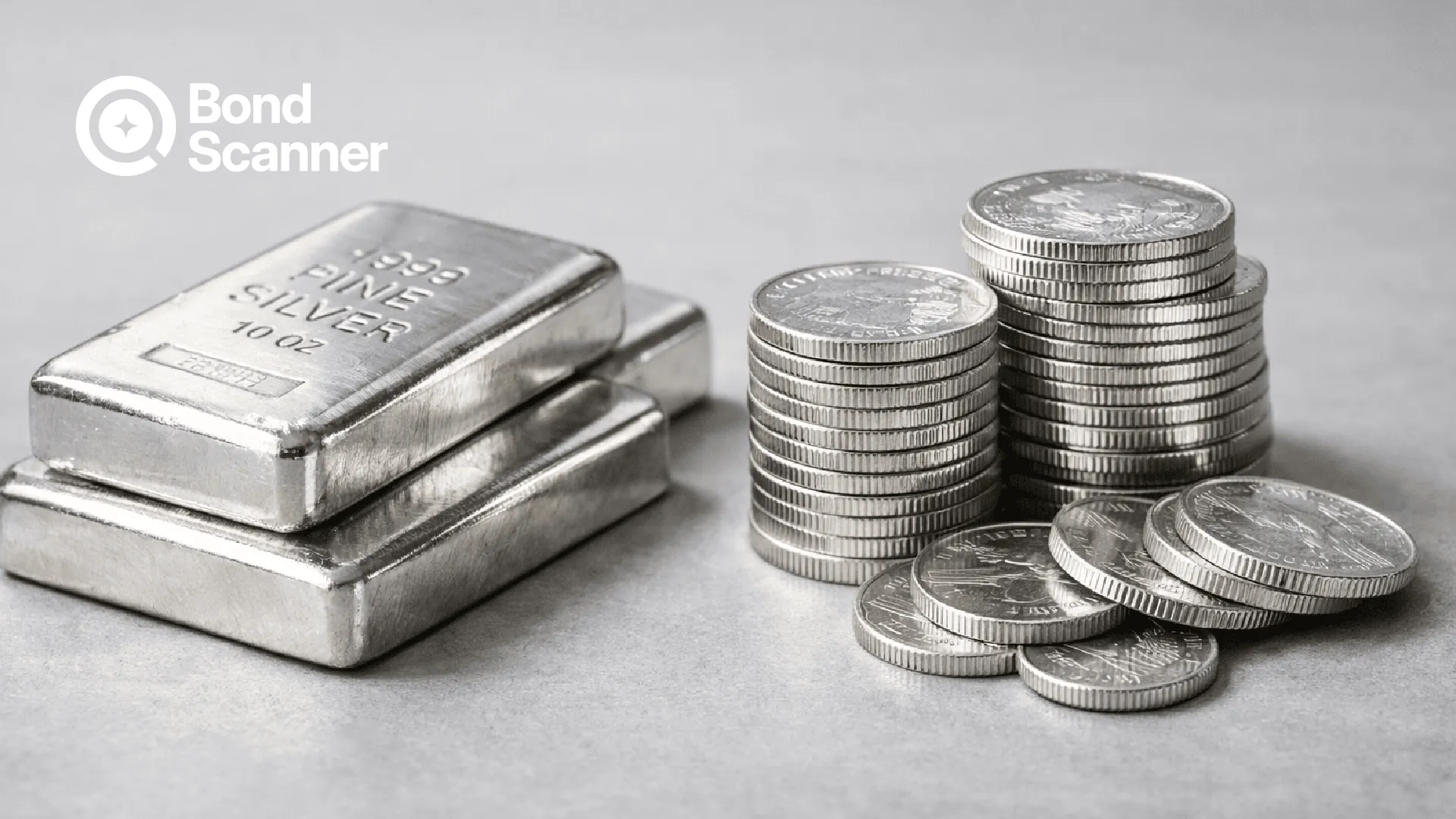
A Silver ETF is an exchange-traded fund that tracks the domestic price of silver. When you buy units of a Silver ETF, you gain exposure to silver price movements without physically holding the metal. The fund holds physical silver or silver-backed instruments, and its net asset value (NAV) moves in line with silver prices.
Silver ETFs are listed on NSE and BSE, held in Demat form, and regulated by SEBI under the Mutual Funds Regulations, 1996. They were introduced in India in 2021 following SEBI's approval.
What a Silver ETF is not: A silver ETF does not pay any periodic income no coupon, no dividend, no distribution. The entire return comes from price appreciation when you sell. This is the most fundamental difference from a bond.
Why Silver Has Attracted Investor Attention in 2025–2026
Silver's significant price appreciation in 2025–2026 has been driven by two distinct forces:
Industrial demand growth: Silver is a critical input in solar panel manufacturing, electric vehicles, semiconductors, and electronics. The global clean energy transition has created structural demand for silver that is separate from its role as a precious metal. Unlike gold which is primarily a monetary and jewellery metal silver has an industrial demand floor that provides a different return driver.
Precious metal safe-haven demand: During periods of global uncertainty, dollar depreciation, and elevated inflation, silver like gold tends to attract safe-haven investment flows. In INR terms, a weaker rupee further amplifies domestic silver price returns.
Scale of recent returns: Silver ETFs in India have been spectacular performers in 2025–2026, driven by rising global silver prices, industrial demand from solar energy, and safe haven flows. In the first 20 days of 2026 alone, silver-based ETFs delivered returns exceeding 25% in many cases. These returns are exceptional and are not representative of typical long-term silver investment returns.
How to Invest in Silver in India
| Method | How It Works | Key Advantage | Key Limitation |
|---|---|---|---|
| Silver ETFs | Buy units on NSE/BSE through a Demat account; tracks domestic silver price | No storage, no purity risk, low cost, high liquidity | No periodic income; returns depend entirely on price appreciation |
| Silver ETF Fund of Funds (FoF) | Mutual fund that invests in Silver ETFs; allows SIP investment | Enables systematic monthly investment; no Demat account needed | Slightly higher cost than direct ETF; one additional layer |
| Physical Silver (coins/bars) | Buy physical silver from jewellers, banks, or certified dealers | Tangible ownership | Storage cost, purity risk, making charges, poor buy-back spreads |
| MCX Silver Futures | Derivative contracts on MCX commodity exchange tracking silver price | Leverage available; price discovery mechanism | Requires commodity trading knowledge; rollover costs; not suitable for most retail investors |
For most retail investors, Silver ETFs are the most practical route — they provide silver price exposure at low cost with no storage burden, held in the same Demat account as stocks and bonds.
Major Silver ETFs Available in India 2026
| Fund Name | NSE Symbol | AMC | Approx. Expense Ratio | Key Feature |
|---|---|---|---|---|
| Nippon India Silver ETF | SILVERIETF | Nippon India Mutual Fund | ~0.40% | One of the largest silver ETFs by AUM in India |
| ICICI Prudential Silver ETF | SILVERETF | ICICI Prudential AMC | ~0.40% | Strong AMC backing; well-established fund house |
| Aditya Birla Sun Life Silver ETF | ABSLSILVER | Aditya Birla Sun Life AMC | ~0.45% | Early mover in silver ETF space (2021 launch) |
| Kotak Silver ETF | KOTAKSILVE | Kotak Mahindra AMC | ~0.40% | Backed by one of India's leading private banks |
| HDFC Silver ETF | HDFCSILVER | HDFC AMC | ~0.40% | Large, established AMC with strong distribution |
| Zerodha Silver ETF | SILVERCASE | Zerodha Fund House | 0.39% | Lowest expense ratio among major silver ETFs; strong retail distribution via Zerodha |
Expense ratios and AUM are indicative as of Q2 2026 and subject to change. All silver ETFs are held in Demat form and listed on NSE/BSE. This is not a recommendation to invest in any specific fund.
All major silver ETFs in India hold physical silver bullion stored in SEBI-approved custodians. The tracking error the difference between the ETF's return and the actual silver price movement is typically under 1.5% annually for the larger, more established funds.
How Silver ETFs Work: Key Features
No income generation: Silver ETFs pay no coupon, dividend, or distribution. The return is entirely capital appreciation the difference between your purchase price and sale price. This is the most important feature to understand before comparing with bonds.
Expense ratio: Silver ETFs charge an annual expense ratio typically between 0.39% and 0.50% of AUM. This is deducted from the fund's NAV continuously.
Minimum investment: One unit on the exchange at the prevailing market price typically in the range of Rs. 28 to Rs. 250 per unit depending on the ETF. For Silver ETF FoFs, SIP can be started from as low as Rs. 500 per month.
Liquidity: Major silver ETFs trade on NSE and BSE with reasonable secondary market liquidity during market hours. Smaller funds may have lower trading volumes with wider bid-ask spreads.
Demat holding: Silver ETF units are credited to the investor's existing Demat account the same account used for equities and bonds. No separate account is needed.
Silver ETFs vs Bonds: A Structured Comparison
| Parameter | Silver ETFs | Listed Bonds (Corporate/PSU) |
|---|---|---|
| Income generation | None — no coupon, dividend, or periodic distribution | Fixed coupon paid at regular intervals — monthly, quarterly, semi-annual, or annual |
| Return source | Entirely from silver price appreciation on sale — no income during holding | Fixed coupon income + capital gain if sold before maturity at premium |
| Capital guarantee | None — silver price can fall; investment value can decline | Face value returned at maturity (subject to issuer not defaulting) |
| Price volatility | Very high — silver prices can move 20–30%+ in either direction in a year | Low to moderate for investment-grade bonds held to maturity |
| Inflation linkage | Partial — silver historically benefits from currency depreciation and commodity inflation | None — fixed coupon erodes in real terms when inflation rises |
| Predictability of returns | Zero — cannot predict silver price direction or magnitude | High — coupon rate and maturity value known at time of purchase |
| Minimum investment | One unit at market price — typically Rs. 28 to Rs. 250 | Rs. 10,000 for most primary NCD issues |
| Liquidity | Good for major ETFs on NSE/BSE during market hours | Varies — major PSU bonds liquid; smaller NCDs may be thin |
| Credit risk | No issuer credit risk — backed by physical silver held by custodian | Issuer default risk; mitigated by credit rating but not eliminated |
| Regulation | SEBI Mutual Funds Regulations — AMC regulated by SEBI | SEBI NCS Regulations 2021; listed on NSE/BSE |
The fundamental distinction: A bond investor receives a defined income stream and gets their capital back at maturity the return is contractual. A silver ETF investor receives no income and their capital is entirely at risk based on silver price movements the return is speculative in direction and magnitude.
Return Comparison: Silver ETFs vs Bonds in 2026
| Instrument | 1-Year Return (Indicative) | Return Type | Income During Holding | Capital Guarantee |
|---|---|---|---|---|
| Nippon India Silver ETF | ~173% (exceptional; driven by silver price rally) | Capital appreciation only | None | No |
| Silver ETFs (average long-term CAGR) | 10–12% p.a. historically (long-term estimate; highly variable) | Capital appreciation only | None | No |
| AAA PSU Bonds (PFC, REC, IRFC) | 7.0%–7.5% p.a. (fixed coupon) | Fixed coupon income | Yes — semi-annual or annual | Face value at maturity |
| AA Corporate Bonds | 8.0%–9.5% p.a. (fixed coupon) | Fixed coupon income | Yes — various frequencies | Face value at maturity |
| Bank Fixed Deposits (large banks) | 6.25%–6.50% p.a. (fixed) | Fixed interest | Yes | Up to Rs. 5 lakh (DICGC) |
Silver ETF 1-year return is based on the exceptional 2025–2026 price rally and is not representative of typical long-term performance. Bond and FD yields are indicative as of Q2 2026. Not a recommendation.
The 173% 1-year return on silver ETFs in 2025–2026 is exceptional and driven by an unusual confluence of industrial demand, safe-haven flows, and global supply constraints. These returns of 200%+ in silver ETFs are exceptional investors should not chase recent performance and instead invest for long-term diversification, not short-term momentum. Over a longer horizon, silver's average annual return has been considerably lower and more variable than this exceptional period suggests.
Taxation: Silver ETFs vs Bonds
| Parameter | Silver ETFs | Listed Bonds |
|---|---|---|
| Periodic income tax | Not applicable — no periodic income | Coupon taxed at slab rate as Income from Other Sources |
| TDS on income | Not applicable | No TDS on listed bonds in Demat form for resident Indians |
| Short-term capital gains | Held 12 months or less — taxed at applicable income tax slab rate | Held 12 months or less — taxed at applicable income tax slab rate |
| Long-term capital gains | Held more than 12 months — taxed at 12.5% without indexation | Held more than 12 months — taxed at 12.5% without indexation |
| Holding period for LTCG | 12 months | 12 months |
| Tax on maturity / redemption | Capital gains as above on any profit | No capital gains if held to maturity (coupon-bearing bonds); only income tax on coupons |
Key tax distinction: Bonds held to maturity attract only income tax on coupons - no capital gains tax. Silver ETFs always trigger capital gains on exit.
For complete bond taxation details, refer to Taxation on Bonds in India: Comprehensive Guide.
Risks of Investing in Silver ETFs
Price volatility: Silver is significantly more volatile than gold and far more volatile than bonds. Annual price swings of 30–50% in either direction are not unusual. An investor who bought silver ETFs near a peak and needs to exit during a trough can face substantial losses.
No income buffer: Unlike bonds — which continue paying coupons even when prices fall — silver ETFs generate no income during a price decline. The investor simply holds a depreciating asset with no cash return until they sell.
Industrial demand cyclicality: While industrial demand for silver is a structural long-term driver, it is also cyclical. A global economic slowdown that reduces manufacturing activity, EV adoption, or solar installations can sharply reduce silver demand and prices.
Currency risk: Silver is priced globally in USD. A stronger rupee reduces the INR-denominated return from silver price appreciation — meaning global silver gains may be partially or fully offset by rupee appreciation.
Tracking error: Silver ETFs may not perfectly replicate silver price movements due to fund expenses, custodian fees, and rebalancing. Over long periods, tracking error compounds and reduces the investor's effective return relative to actual silver price appreciation.
No capital protection: Unlike bonds which return face value at maturity, silver ETFs have no floor. Silver prices can fall 40–50% from peak levels as they have done in previous cycles (2011–2015, for example). An investor with a short time horizon who needs capital at a specific date faces meaningful capital risk.
Who Should Consider Silver ETFs?
Silver ETFs may be worth evaluating as a portfolio diversification tool — not as a substitute for bonds — for investors who:
Already have a bond and fixed deposit allocation covering their income and capital protection needs
Want a small allocation (5–10% of portfolio) to commodities for inflation and currency hedging
Have a medium to long-term horizon (5 years or more) to ride out price volatility
Do not need periodic income from this portion of their investment
Understand that recent exceptional returns are not representative of long-term typical performance
Silver ETFs are not suitable as bond substitutes for investors who:
Require periodic, contractually defined income
Need capital return at a specific future date
Cannot tolerate price swings of 30–50% in either direction
Are investing with a short time horizon under 2 years
For bond investors building a fixed-income portfolio, the relevant comparison instruments are PSU bonds, corporate NCDs, and government securities — not silver ETFs. To explore listed bonds available in India, visit bondscanner.com/bonds. For a comparison of fixed-income instruments, refer to Safe Investments with High Returns in India: Bonds vs FDs.
FAQs
What is a Silver ETF in India?
A Silver ETF is a SEBI-regulated exchange-traded fund that tracks the domestic price of silver. It holds physical silver or silver-backed instruments and is listed on NSE and BSE. Investors gain silver price exposure without physically holding the metal. Silver ETFs pay no periodic income — all returns come from price appreciation on sale.
How do silver ETFs compare to bonds in India?
Silver ETFs and bonds are fundamentally different. Silver ETFs offer no coupon income — returns come entirely from price appreciation, which is highly volatile and unpredictable. Bonds offer contractually fixed coupons and principal return at maturity. Silver ETFs have delivered exceptional returns in 2025–2026 but with high volatility. Bonds deliver predictable, lower returns with capital protection.
How are silver ETFs taxed in India?
Silver ETFs held for 24 months or less are taxed as STCG at the investor's applicable slab rate. Held for more than 24 months, gains are taxed as LTCG at 12.5% without indexation. There is no periodic income or TDS on silver ETFs.
Which silver ETFs are available in India in 2026?
Major silver ETFs in India include Nippon India Silver ETF, ICICI Prudential Silver ETF, Aditya Birla Sun Life Silver ETF, Kotak Silver ETF, HDFC Silver ETF, and Zerodha Silver ETF. All are listed on NSE and BSE and held in Demat form.
Should I invest in silver ETFs instead of bonds?
Silver ETFs and bonds serve different purposes — they are not alternatives to each other. Bonds provide contractual income and capital protection; silver ETFs provide commodity exposure with price appreciation potential and high volatility. This is an educational observation, not a recommendation. Investors should evaluate their income needs, risk tolerance, and time horizon before allocating to either instrument.
What is the minimum investment in a silver ETF?
One unit at the prevailing market price. Silver ETF unit prices vary by fund and change daily — most major silver ETFs are priced between Rs. 28 and Rs. 250 per unit as of Q2 2026. For Silver ETF FoFs, SIPs can be started from as low as Rs. 500 per month.
Is silver a better investment than gold in India?
Silver has outperformed gold in recent periods but carries higher volatility. Gold is primarily a monetary and safe-haven asset; silver has an additional industrial demand driver from solar, EV, and electronics sectors. Both are commodity assets with no income generation — they serve different portfolio purposes than bonds. This is an educational observation, not a recommendation.
This article is published by BondScanner, a SEBI-registered Online Bond Platform Provider (OBPP). Links to BondScanner's bond listing page, Android app, and iOS app referenced in this article are for informational purposes only.
Explore listed bonds on the BondScanner app:
Disclaimer
This blog is intended solely for educational and informational purposes. The instruments, issuer categories, yield ranges, and examples mentioned herein are illustrative and should not be construed as investment advice or recommendations.
BondScanner is a SEBI-registered OBPP and does not provide personalised investment advice. Nothing in this article is a solicitation to buy or sell any security.
Recent Blogs

Buying bonds? These 5 mistakes could be quietly increasing your risk
A practical retail guide to navigating corporate debt highlighting why chasing headline yields, ignoring concentration risk, and overlooking secondary market illiquidity can undermine your portfolio.

Nishchay Nath
06 Oct 2026

Comparisons
Edelweiss vs Muthoot Fincorp NCDs: Which high-yield issue wins?
Missed the Muthoot Fincorp NCD? A side-by-side comparative guide to locking in up to 10.00% per annum with Edelweiss Financial Services—breaking down CRISIL ratings, risk-reward tradeoffs, and portfolio allocation rules.

Atharva Joshi
06 Oct 2026
Founder's Notes
India’s bond market does not need more education, it needs better products
Why closing the ₹214 lakh crore gap between bank deposits and corporate bonds requires simpler product architecture, tokenized fractionalization, and seamless wallet-driven investing rather than endless investor education.
Nishchay Nath
30 Sep 2026
Issuer Spotlights
Understanding SMC global securities bonds: returns, credit rating & risk factors
A comprehensive investor guide to SMC Global Securities Limited NCDs, breaking down diversified financial services, annual cash flows, CRISIL A credit ratings, secondary market yields, and risk parameters.

Subham Mishra
28 Sep 2026