fixed Income, sovereign Backed
fixed Income, sovereign Backed
fixed Income, sovereign Backed
Government Bonds
Stability Built on Sovereign Trust
Tenure less than 13 months
Backed by sovereign credit
Tenure less than 13 months
Tenure less than 13 months
Tenure less than 13 months
Approx 7.5% avg returns
Start with as low as ₹100/unit
Approx 7.5% avg returns
Tax advantage
Start with as low as ₹100/unit
Tenure less than 13 months
Tenure less than 13 months
Backed by sovereign credit
Tenure less than 13 months
Near Zero Default Risk
Approx 7.5% Avg Returns
Start with as low as ₹100/unit
Tax Advantage

Tenure less than 13 months
Government Bonds (or G-Secs) are debt instruments issued by the Reserve Bank of India on behalf of the central or state government. When you invest in a government bond, you are lending money to the government. In return, you earn fixed interest (called a coupon) and receive your principal at maturity.
Stability deserves performance too. With yields reaching up to 7%, Government Bonds bring fixed-income security and attractive returns together.
Stability deserves performance too. With yields reaching up to 7%, Government Bonds bring fixed-income security and attractive returns together.
up to
5.7%
Returns
Returns
up to
5.7%
Backed by
Backed by
Government of india

Is Your "Safe" Money Really Working?
Is Your "Safe" Money Really Working?
All your money in one place
View your income, expense and spending across all your different accounts.
All your money in one place
View your income, expense and spending across all your different accounts.
Track where your money goes
Break down your spending into clear, simple categories and time periods.
Track where your money goes
Break down your spending into clear, simple categories and time periods.
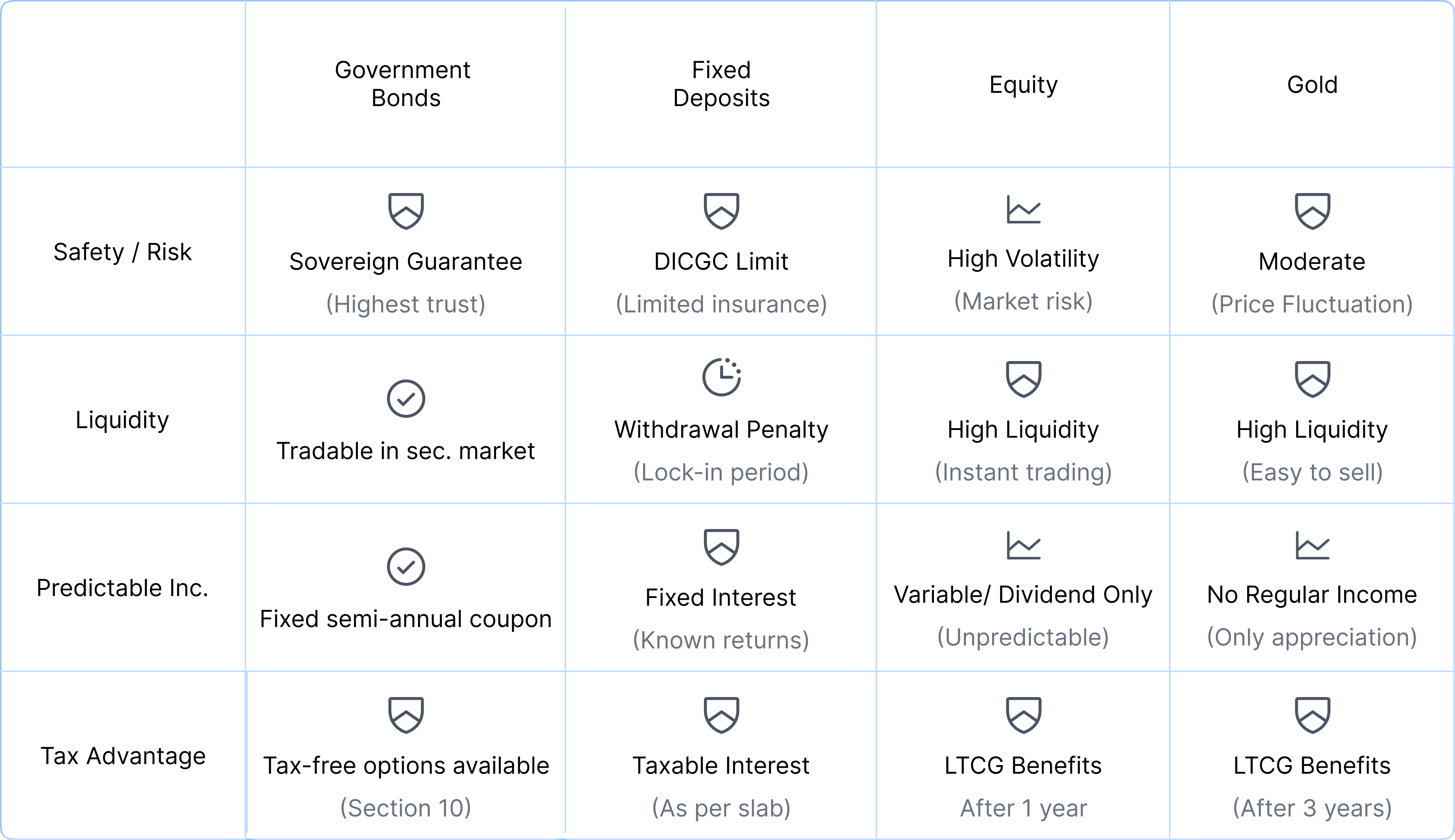
A clear overview of how G-Secs stand on stability, returns, and tax efficiency alongside options such as Fixed Deposits, Equity, and Gold.
A clear overview of how G-Secs stand on stability, returns, and tax efficiency alongside options such as Fixed Deposits, Equity, and Gold.
Safety / Risk
Safety / Risk
Liquidity
Predictable Inc.
Tax Advantage
Government
Bonds
Sovereign Guarantee
(Highest trust)
Tradable in sec. market
Fixed semi-annual coupon
Tax-free options available
(Section 10)
Fixed
Deposits
DICGC Limit
(Limited insurance)
Withdrawal Penalty
(Lock-in period)
Fixed Interest
(Known returns)
Taxable Interest
(As per slab)
Equity
High Volatility
(Market risk)
High Liquidity
(Instant trading)
Variable/ Dividend Only
(Unpredictable)
LTCG Benefits
(After 1 year)
Gold
Moderate
(Price Fluctuation)
High Liquidity
(Easy to sell)
No Regular Income
(Only appreciation)
LTCG Benefits
(After 3 years)
Stability Isn't One Size Fits-All
Stability Isn't One Size Fits-All
Find the exact bond type that fits your timeline, from 91 days to 40 years
Find the exact bond type that fits your timeline, from 91 days to 40 years
Treasury Bills (T-Bills)
Treasury Bills (T-Bills)
Short-term instruments for parking funds, maturing quickly in 91, 182, or 364 days. They are issued at a discount to face value, offering quick, predictable returns.
Government Dated Securities (G-Secs)
Government Dated Securities (G-Secs)
The standard long-term bonds, with maturities ranging from 1 to 40 years. These pay a fixed interest (coupon) semi-annually, offering steady income flow.
State Development Loans (SDLs)
State Development Loans (SDLs)
Bonds issued directly by various state governments for their own projects. They carry sovereign backing and offer a simple way to diversify your portfolio.
Sovereign Gold Bonds (SGBs)
Sovereign Gold Bonds (SGBs)
Bonds linked to the price of physical gold without the hassle of storage. They offer both capital appreciation and a fixed annual interest payment.
Treasury Bills (T-Bills)
Government Dated Securities (G-Secs)
The standard long-term bonds, with maturities ranging from 1 to 40 years. These pay a fixed interest (coupon) semi-annually, offering steady income flow.
Treasury Bills (T-Bills)
Short-term instruments for parking funds, maturing quickly in 91, 182, or 364 days. They are issued at a discount to face value, offering quick, predictable returns.
State Development Loans (SDLs)
Bonds issued directly by various state governments for their own projects. They carry sovereign backing and offer a simple way to diversify your portfolio.
Inflation-Indexed Bonds
Inflation-Indexed Bonds
Specifically designed to protect your investment's purchasing power over time. Principal and/or coupon payments are automatically adjusted for inflation.
Treasury Bills (T-Bills)
Tax-Free Bonds
Tax-Free
Bonds
Issued by government-backed entities like NHAI or PFC for infrastructure. The interest earned is completely exempt from income tax under Section 10.
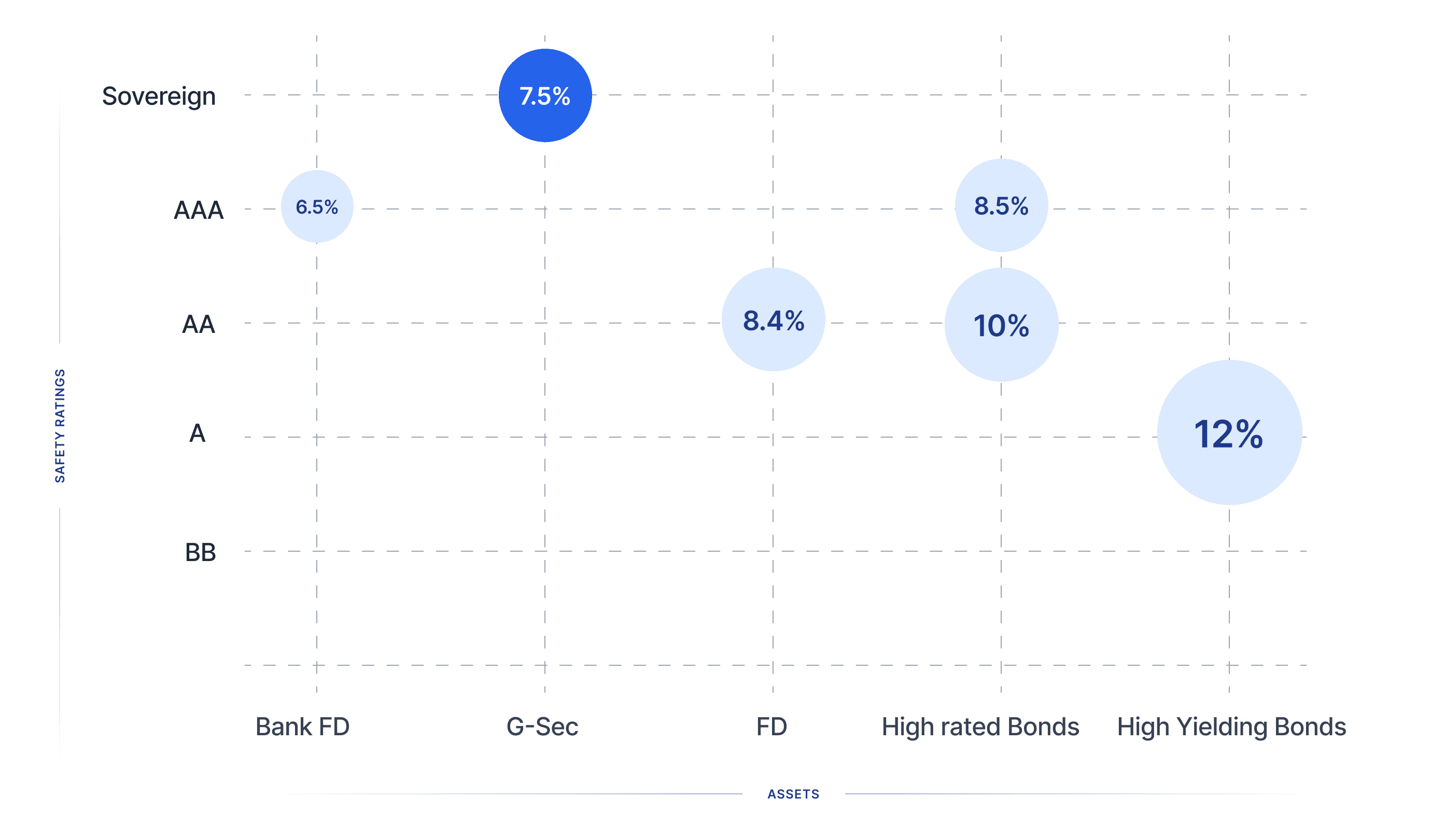
Find the Financial Sweet Spot
Find the Financial Sweet Spot
Visualize where G-Secs land against every other major fixed-income asset
Visualize where G-Secs land against every other major fixed-income asset
Still got questions?
We’re here to help.
What does one mean by government security?
Government bonds/ security (G-Sec) means a security created and issued by the Central and State Governments for the purpose of raising a public loan or mainly for capital expenditure, financing a budget deficit, or infrastructure development as notified by the Government in the Official Gazette. Government securities offer the benefits of safety, liquidity, and attractive returns to institutional or non-institutional investors, individuals, and non-individuals. G-Secs are available to invest usually in a range from 91 days to 40 years.
Are government bonds good investment?
Government bonds offer consistent revenue, can be pledged as security for a loan, and interest gained on this is not subjected to TDS and also is the safest investment as it is backed by the Government of India.
How to buy government bonds through BondScanner?
Investors can invest in Government bonds just in 2 simple steps - 1. Complete your KYC, 2. Transfer the Fund Online. After the successful payment, bond units will be credited to your Demat account on T+1 day.
Can NRI Invest in government bonds?
Non-Resident Indians (NRIs) and Overseas Citizens of India (OCI) are both eligible to subscribe to government bonds in the form of new or re-issuance when the securities are issued. The NRIs can invest in G-Secs through Non PIS NRO account which is non-repatriable in nature to buy G-Secs or SDLS. You can buy or sell government bonds in the secondary market. For buying and selling assistance you can contact your relationship manager at BondScanner.
How to sell government Bonds?
You can sell government bonds through the NDS-OM and cash segment of the exchange.
What is the minimum investment in the government security bonds in 2025?
Investors can generally start with a minimum transaction amount of₹100- ₹1,000 in most Government Securities. This applies to: Treasury Bills (T-Bills) Dated Government Securities (long-term G-Secs) State Development Loans (SDLs)
What does one mean by government security?
Government bonds/ security (G-Sec) means a security created and issued by the Central and State Governments for the purpose of raising a public loan or mainly for capital expenditure, financing a budget deficit, or infrastructure development as notified by the Government in the Official Gazette. Government securities offer the benefits of safety, liquidity, and attractive returns to institutional or non-institutional investors, individuals, and non-individuals. G-Secs are available to invest usually in a range from 91 days to 40 years.
Are government bonds good investment?
Government bonds offer consistent revenue, can be pledged as security for a loan, and interest gained on this is not subjected to TDS and also is the safest investment as it is backed by the Government of India.
How to buy government bonds through BondScanner?
Investors can invest in Government bonds just in 2 simple steps - 1. Complete your KYC, 2. Transfer the Fund Online. After the successful payment, bond units will be credited to your Demat account on T+1 day.
Can NRI Invest in government bonds?
Non-Resident Indians (NRIs) and Overseas Citizens of India (OCI) are both eligible to subscribe to government bonds in the form of new or re-issuance when the securities are issued. The NRIs can invest in G-Secs through Non PIS NRO account which is non-repatriable in nature to buy G-Secs or SDLS. You can buy or sell government bonds in the secondary market. For buying and selling assistance you can contact your relationship manager at BondScanner.
How to sell government Bonds?
You can sell government bonds through the NDS-OM and cash segment of the exchange.
What is the minimum investment in the government security bonds in 2025?
Investors can generally start with a minimum transaction amount of₹100- ₹1,000 in most Government Securities. This applies to: Treasury Bills (T-Bills) Dated Government Securities (long-term G-Secs) State Development Loans (SDLs)
What does one mean by government security?
Government bonds/ security (G-Sec) means a security created and issued by the Central and State Governments for the purpose of raising a public loan or mainly for capital expenditure, financing a budget deficit, or infrastructure development as notified by the Government in the Official Gazette. Government securities offer the benefits of safety, liquidity, and attractive returns to institutional or non-institutional investors, individuals, and non-individuals. G-Secs are available to invest usually in a range from 91 days to 40 years.
Are government bonds good investment?
Government bonds offer consistent revenue, can be pledged as security for a loan, and interest gained on this is not subjected to TDS and also is the safest investment as it is backed by the Government of India.
How to buy government bonds through BondScanner?
Investors can invest in Government bonds just in 2 simple steps - 1. Complete your KYC, 2. Transfer the Fund Online. After the successful payment, bond units will be credited to your Demat account on T+1 day.
Can NRI Invest in government bonds?
Non-Resident Indians (NRIs) and Overseas Citizens of India (OCI) are both eligible to subscribe to government bonds in the form of new or re-issuance when the securities are issued. The NRIs can invest in G-Secs through Non PIS NRO account which is non-repatriable in nature to buy G-Secs or SDLS. You can buy or sell government bonds in the secondary market. For buying and selling assistance you can contact your relationship manager at BondScanner.
How to sell government Bonds?
You can sell government bonds through the NDS-OM and cash segment of the exchange.
What is the minimum investment in the government security bonds in 2025?
Investors can generally start with a minimum transaction amount of₹100- ₹1,000 in most Government Securities. This applies to: Treasury Bills (T-Bills) Dated Government Securities (long-term G-Secs) State Development Loans (SDLs)